CV
Qingyu Mei (Satopikac)
College of Engineering, Peking University
Robotics Engineering · Beijing, China
GitHub: satopikac
Email: link@0506078.xyz /
qymei1898@gmail.com
Research in AI + Robotics, interests including Embodied Intelligence, Robot RL, Vision-Language-Action (VLA) Models, Multimodal Fusion, and Multi-Robot Collaboration, dedicated to advancing intelligent robotics technology and applications.

Education

Spring days in PKU
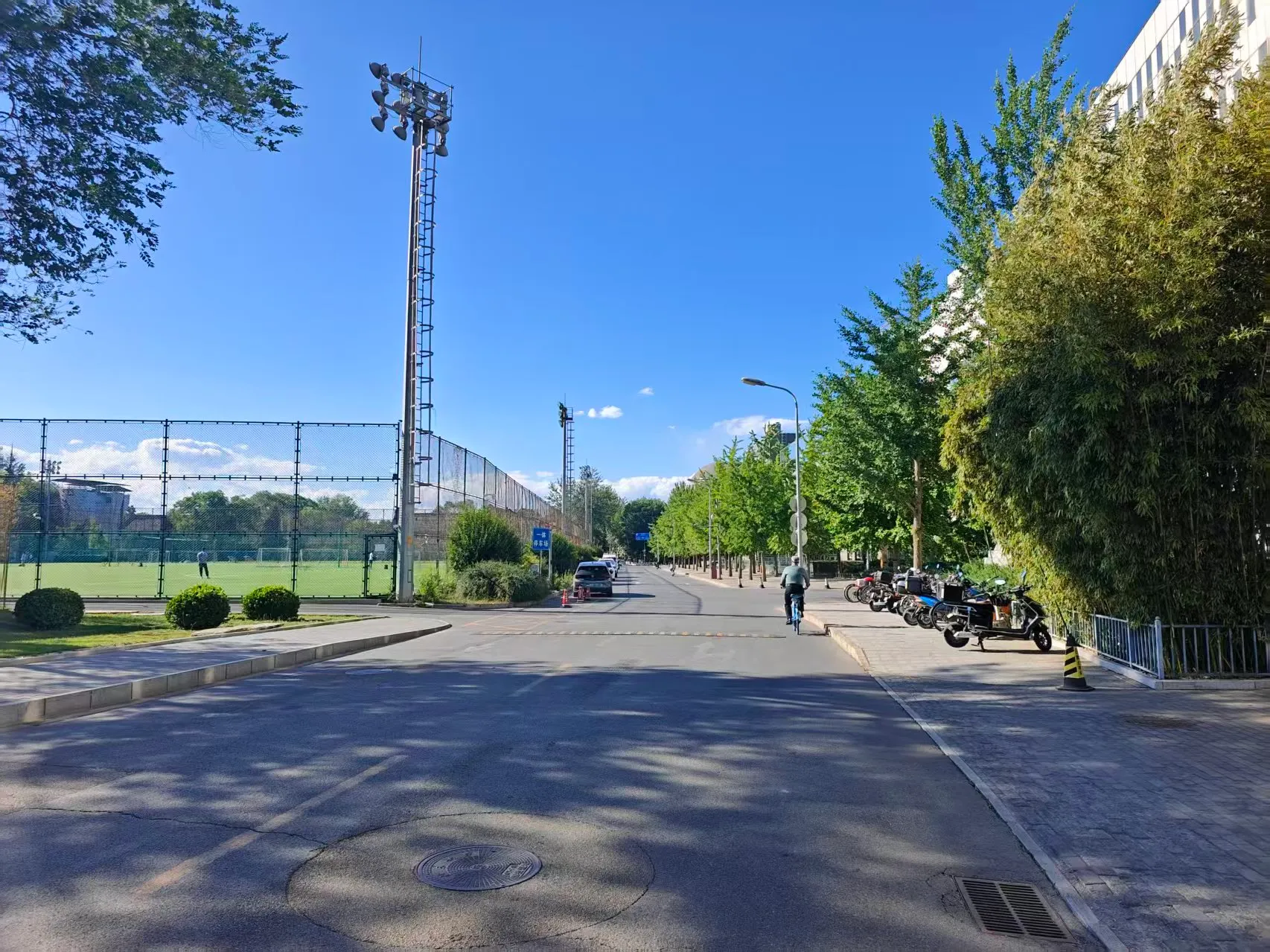
Hot Summer
Sept. 2022 - July 2026:
Peking University, College of Engineering, B.S.E. in Robotics Engineering with Honors. GPA: 3.735/4.0 (88/100), Rank: 3rd in Major
2026 - :
Peking University, School of Advanced Manufacturing and Robotics, Master of Mechanical Engineering (Commencing September 2026)
Core Courses:
Theoretical Mechanics, Advanced Dynamics, Introduction to Robotics, Principles of Automatic Control, Signals and Systems, Analog and Digital Electronics, Robotics Dynamics, Machine Learning and Deep Learning, Fundamentals of Large Language Models, Computer Science, Embodied AI
Research Projects
2025 - 2026: An Embodied AI Agent for Semantic Perception and Navigation
Project Developer · Peking University · Advisor: Prof. Meng Guo
We develop a robotic embodied navigation agent and propose a hierarchical agent design. The agent perceives the robot's environment, acquires environmental semantic information, understands and assigns natural language navigation commands, and controls multiple robots to accomplish collaborative tasks.
- Selected as an Outstanding Undergraduate Thesis by the College of Engineering, Peking University
2024 - Present: Semantic Navigation, Point Cloud Semantic Segmentation and Multi-Robot Collaboration
Engaged in semantic navigation technology research and point cloud semantic segmentation development. Explored multi-robot collaboration mechanisms for coordinated tasks.
2024 - 2025: Multi-Robot Collaborative Autonomous Exploration, Mapping and Navigation with Robotic-Arm Grasping
Project Participant · Peking University
- Implemented 2D map construction in indoor environments using LiDAR on a mobile robot platform
- Participated in multi-robot experiments on collaborative autonomous exploration and real-time 2D mapping in indoor environments using LiDAR-equipped mobile robots
- Utilized depth camera to generate spatial point clouds as physical obstacles for robotic arm grasping path planning
- Achieved robot navigation based on the constructed map, integrating collaborative grasping with robotic arm
- Carried out map-based autonomous navigation with coordinated path planning across multiple mobile robots
- Validated coordinated exploration, navigation, and grasping performance in both indoor and simulated environments
2025 - 2026: MiniMind Open-Source Small Language Model
Project Developer
- Implemented the model architecture and core training components for pretraining, supervised fine-tuning, and LoRA fine-tuning
- Built the tokenizer and text-processing pipeline for preparing and encoding training data
- Integrated the components into an initial functional small language model capable of text generation
Internship Experience
July 2026 - Aug. 2026: Microsoft Research Asia, Spatial Intelligence Group
Research Intern · Beijing, China · Mentor: Lin Luo
- Collected teleoperation data for vision-language-action models
- Deployed and fine-tuned vision-language-action models and ran inference for robotic manipulation
- Developed, deployed, and tested an embodied manipulation agent that plans a long-horizon task into a sequence of atomic tasks, automatically judges the execution outcome of each atomic task, and triggers a retry or a jump to another subtask, improving the success rate of long-horizon task execution

Beautiful autumn days in Peking University campus

And winter days
Academic Awards
- 2025: National Scholarship (Ministry of Education of the People's Republic of China)
- 2025: Pacemaker to Merit Student, Peking University
- 2024: Third Prize of Peking University
- 2024: Model Student of Academic Records, Peking University
- 2023: Merit Student of Peking University
- 2023: Schlumberger Scholarship, First Class, College of Engineering, Peking University
Technical Skills
- Programming Languages: C++, C Language, Python, PyTorch, MATLAB
- Engineering Software: AutoDesk Fusion, SolidWorks, Mechanical Design
- Robotics Stack: Linux and ROS, IsaacLab
- Research: Robotics Dynamics, Automatic Control, Embodied AI, Machine Learning, Vision-Language-Action Models
- Languages: Chinese (Native); English — National College English Test Band 6 (CET-6) Score: 555, IELTS in preparation
- Research Areas: Embodied Intelligence, Vision-Language-Action Models, Multimodal Fusion, Multi-Robot Collaboration
Research Interests
AI + Robotics, including Embodied Intelligence, Vision-Language-Action (VLA) Models, World Models,etc.
I am interested in building intelligent agents that can perceive, reason about, and interact with the physical world, and in developing algorithms that enable humanoid robots, mobile robots, and robotic manipulators to autonomously perform complex, long-horizon tasks.